AI Agents
Agents can interpret context and support research, coordination, service support, and knowledge work. Their role is to help make information useful within defined boundaries.
Interpret context. Coordinate information.
Context-aware agents and intelligent automation can coordinate work across systems, information, and processes while preserving defined boundaries and human accountability.
From tasks to coordinated work
Traditional task automation follows defined steps. Agentic capability can potentially interpret context, bring relevant information together, and support the next appropriate action within an agreed scope.
The distinction is not freedom from oversight. It is the ability to carry useful context into a controlled process, with people retaining authority over the decisions that require judgment.
Two connected capabilities
Agents can interpret context and support research, coordination, service support, and knowledge work. Their role is to help make information useful within defined boundaries.
Interpret context. Coordinate information.
Automation can connect repeatable actions, move information, and carry out defined process steps. System-to-system coordination depends on the permissions and connections established for the workflow.
Connect steps. Execute defined actions.
Agents can interpret and coordinate. Automation can execute defined actions. The value comes from designing how the two work together responsibly.
Controlled orchestration
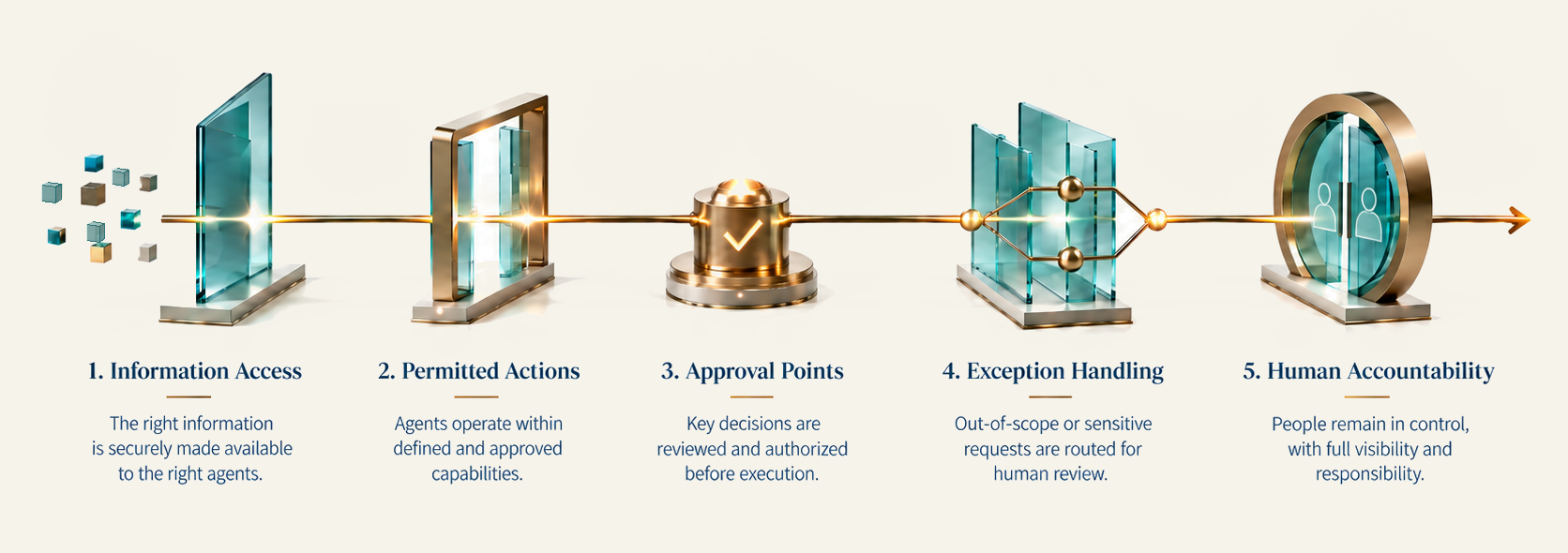
The intended operating model gives each action a defined scope, a clear authority, and a path for review.
The right information is securely made available to the right agents.
Agents operate within defined and approved capabilities.
Key decisions are reviewed and authorized before execution.
Out-of-scope or sensitive requests are routed for human review.
People remain in control, with full visibility and responsibility.
Illustrative applications
These are illustrative developing applications, not generally available services. They describe areas for exploration, not confirmed integrations or promised outcomes.
Gather and organize information from permitted sources to support human analysis and review.
Bring relevant context together so people can see dependencies, outstanding work, and the next defined step.
Support repeatable work behind service delivery, with approval requirements and exceptions kept visible.
Help locate, compare, and prepare information for people to assess and use.
Move approved information to the appropriate next step in a defined workflow, subject to access and action limits.
The boundary is part of the design
An uncertain input, a missing permission, or a step outside the agreed scope should trigger a pause rather than an improvised action.
Defined escalation, review, and exception paths allow an accountable person to resolve the issue and authorize what happens next. Controlled execution includes knowing when not to proceed.
AI Agents & Intelligent Automation is a developing part of Verascend’s broader transformation portfolio. It is not generally available.
We will expand this capability only where it can be delivered with rigor, appropriate controls, and measurable business relevance. Current conversations help us understand potential needs; they do not imply a ready-to-deploy product or confirmed system integration.
Start a conversation